Oven Preheats Slowly in Claremont
Forty minutes to 350°F, and the 'preheated' beep arrives at an oven that's still climbing. Slow preheats are the early-warning form of several failures that end as no-heat calls.
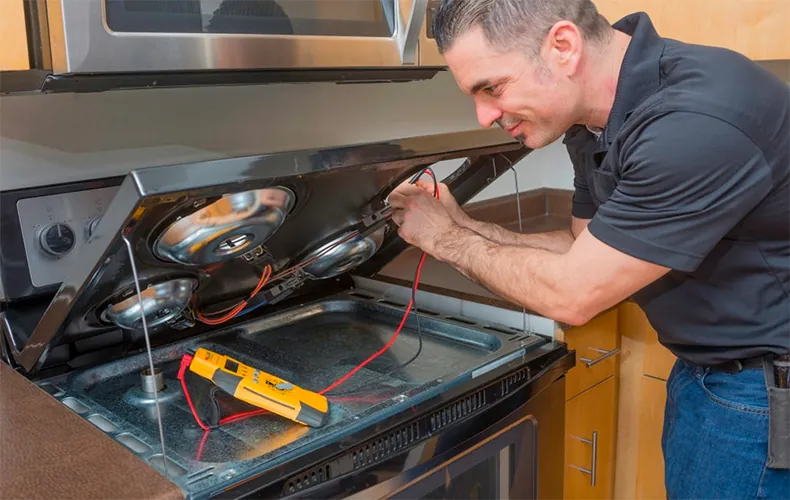
What's going on with your oven
A healthy oven reaches 350°F in roughly 10–20 minutes depending on design. One that takes twice that — or beeps 'ready' long before it is — is telling you its heat system is weakened: an igniter that lights the burner late and weakly, an element losing its output, a sensor misjudging the climb. Slow preheat is worth attention precisely because it's the rehearsal for a full no-heat failure, usually on a holiday.
Claremont sits about 47 miles from our Reseda base, on the 210-corridor run we drive daily — same-day visits are straightforward.
How urgent is it? Book within a couple of weeks — it's a failure in rehearsal, and the performance is always scheduled for a dinner party.
What causes oven preheats slowly
Every one of these is found by testing, not guessing — the diagnostic confirms which one you have before any part is quoted.
What you can safely check yourself
- Time it honestly: empty oven, set 350°F, how long to the beep — and if you have an oven thermometer, what does it read at the beep? The pair of numbers is the diagnosis's headline.
- Gas ovens: watch the ignition delay after you set bake — a long pause before the burner lights, repeated through the cycle, is the igniter aging in public.
- Inspect the bake element (electric, cool oven) for blistered or broken sections along its length.
- Check the door seal with the dollar-bill test around the frame while you're at it.
What our technician checks
Preheat is measured, not vibes: time-to-temperature with a calibrated probe, igniter draw (the number that predicts its remaining life), element output and condition, sensor accuracy against its chart. The weakening link is replaced before it graduates — slow-preheat repairs are how ovens avoid dying on Thanksgiving.
Parts most often involved in this repair: oven igniters, bake elements, temperature sensors and door gaskets. Each is identified against your exact model number — no universal substitutes.
In Claremont the diagnostic visit is $95 — and nothing is hidden inside it: the technician tests the appliance properly, identifies the failed part by your model number, and quotes one total for the complete repair. Say yes and the diagnostic fee is credited toward the bill. Say no and that's the end of it — just the diagnostic fee, no pressure. The work itself is covered for 1 month on labor and 3 months on parts.
Oven Preheats Slowly in Claremont — questions
How long should an oven take to preheat?
Most reach 350°F in 10–20 minutes; larger cavities and some designs run longer. Double your model's normal time — whatever it used to be — is the meaningful threshold.
Why does my oven beep 'preheated' when it isn't?
Because the control believes its sensor. A drifting sensor declares victory early. Verifying with a thermometer at the beep separates sensor lies from weak heat.
Is a slow preheat worth a service call by itself?
Yes — it's the cheapest version of the repair you're otherwise booking later as 'oven not heating,' with worse timing.
Oven & Range repair in Claremont
This problem in nearby cities
More oven problems in Claremont
Oven & Range error codes in Claremont
Not in Claremont? Read the general guide: Oven Preheats Slowly · All appliance problems & error codes · See every city in our service area
Book oven repair in Claremont
Same-day slots fill up by midday. Call or email and we'll lock in your window.
Diagnostic $95 in Claremont — free when you repair with us. Full price in writing before we start. Labor warranty 1 month, parts warranty 3 months.
Book your visit online
Fill in the form, pick a day and an arrival window that work for you — your visit is reserved instantly. Prefer to talk? Call (747) 218-2666.
What will your diagnostic visit cost?
Pick your city and a few details — you see your exact diagnostic price before you book. The full diagnostic fee is credited toward your repair if you proceed with it.